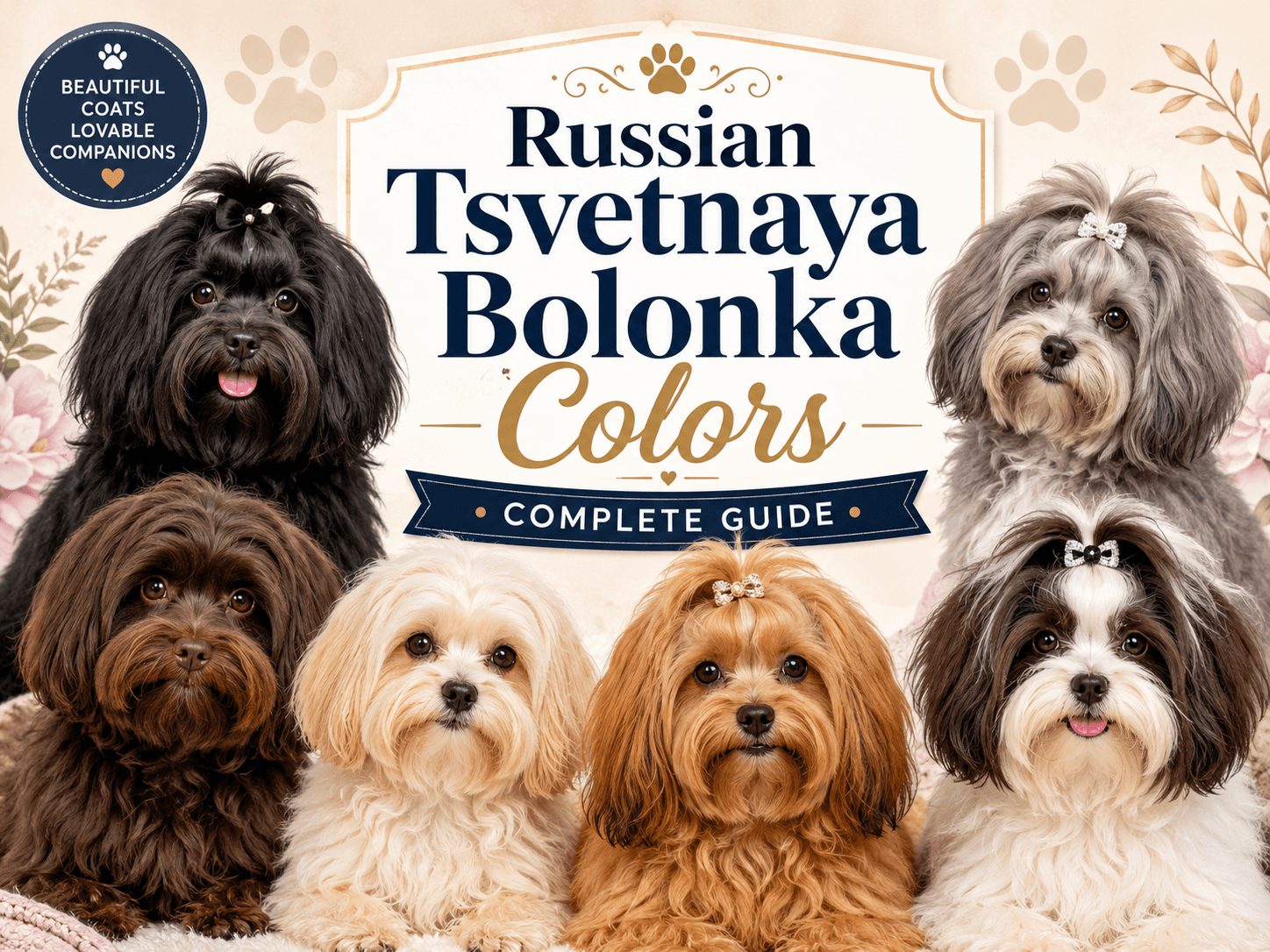
"Tsvetnaya" Means "Colored" — Here's What's Possible
The Russian Tsvetnaya Bolonka — literally "Russian Colored Lapdog" — was specifically bred to be a colored alternative to the all-white Bichon family lapdogs (Bichon Frise, Maltese, Bolognese). The AKC breed standard excludes solid white, preserving the breed's defining characteristic. Here are all the colors you'll encounter in 2026, ordered roughly by frequency.
Black
Jet black is the most common Russian Tsvetnaya Bolonka coat color. A true black coat is rich and uniform from root to tip, often with a slight bluish sheen in sunlight. Black puppies frequently lighten as they age — some retain full black into adulthood, others soften toward dark gray, charcoal, or silver. Black coats hide tear-staining and dirt better than lighter colors, making them practical low-maintenance choices.
Chocolate (Dark Brown)
Chocolate Bolonki carry the recessive 'b' gene that converts black pigment to rich dark brown. The color ranges from milk chocolate (warm light brown) to dark chocolate (nearly black-brown). Chocolate noses, paw pads, and eye rims accompany the coat. Less common than black, chocolate often carries a modest price premium. Chocolate puppies typically hold their color better into adulthood than black puppies.
Brown
Distinct from chocolate, brown describes warmer, lighter coats ranging from cinnamon to deep walnut. Many brown Bolonki started as chocolate puppies that lightened with maturity. Brown coats can show variation across the body — slightly darker on the back, lighter underneath. Common pairing with black or chocolate parents.
Blue (Diluted Gray)
Blue is one of the rarest Russian Tsvetnaya Bolonka colors. It is a diluted form of black — a recessive 'd' gene converts black pigment to a soft steel-gray with a cool, almost silvery-blue cast under bright light. True blue Bolonki are uncommon and often carry a $200-$500 premium. The diluted pigment also lightens the nose and paw pads to a slate-blue tone rather than black.
Gray
Gray Bolonki range from charcoal to platinum silver. Many gray adult coats started as black puppies that lightened — the 'graying' gene is common in the breed. Coat can appear nearly uniform or have lighter highlights along the face, chest, and legs. Gray is common but visually striking, particularly in a wavy adult coat.
Red
Red in the Russian Tsvetnaya Bolonka ranges from rich mahogany to warm copper. Less common than black or chocolate, red often appears in puppies whose parents both carry warm-tone genetics. Red noses and paw pads accompany the lighter pigment. The vibrant color shows beautifully in a curly adult coat.
Fawn
Fawn is a soft tan or cream-tan that often carries dark masking around the muzzle and ears. One of the rarest Russian Tsvetnaya Bolonka colors. Pure fawn (without dark mask) is rarer still. Fawn coats tend to deepen slightly as the dog matures rather than lightening like darker base colors.
Parti-Color
Parti-color Bolonki have two or more distinct color patches on the coat — black-and-tan, chocolate-and-cream, gray-and-white tipped, and other combinations. The AKC standard accepts parti-colors as long as no patch is solid white covering the body. Parti-color puppies are visually distinctive and often more expensive due to their rarity.
Frequently Asked Questions
What colors do Russian Tsvetnaya Bolonkas come in?
Russian Tsvetnaya Bolonkas come in black, brown, chocolate, blue (a diluted gray), gray, red, and fawn, plus parti-color combinations. The AKC breed standard excludes solid white and piebald.
Why is white not allowed in the Russian Tsvetnaya Bolonka breed standard?
The name 'Tsvetnaya' literally translates to 'colored' in Russian — the breed was specifically developed to be a colored alternative to the all-white Bichon Frise and Maltese. The AKC breed standard preserves this defining characteristic by excluding solid white.
Do Russian Tsvetnaya Bolonka puppies change color as they grow?
Yes, often dramatically. Many Bolonki are born dark and lighten significantly by adulthood. A puppy born jet black may mature into a steel gray or silver. A chocolate puppy may keep its color or lighten to a warm brown. Predicting adult color from puppyhood requires examining parent coats and grandparent records.
Which color is the rarest?
Blue (a diluted recessive gray) and true fawn are among the rarest. Black is most common. Color genetics in the Bolonka are similar to other Bichon-family breeds — pairing two carriers of a recessive color increases the chances of rare colors in the litter.
Does coat color affect price or temperament?
Rare colors (blue, fawn, certain parti-color combinations) sometimes carry a modest premium of $200-$500 in pricing. Coat color has no documented connection to temperament or health in the Russian Tsvetnaya Bolonka — choose your puppy on personality and breeder-fit, not just color.